The Book of Spores
How everything began, more or less. The creation story of the mushroom gods. Best read in one long, unhurried sit.
How Everything Began, More or Less
In which everything is far too close together, Earth gets ideas about itself, and a cloud of spores wakes up.
In the beginning, there was everything, but it was much smaller and closer together than it is now. And while everything was simple, things didn’t seem quite right.
Nothing had room to be itself. Everything kept bumping into everything else. Blame was distributed liberally and accepted by none. After a long, irresponsible while — there seemed to be a lot more everything and it began to spread out, cool down, and develop opinions about all the other things.
Whether any of this was a good idea remains, to this day, genuinely contested.
When some of the mess had settled enough, it turned out that Earth was, by a remarkable coincidence, the most important ball of dirt in the universe. This is the kind of thing that seems improbable until you consider that every ball of dirt in the universe believes exactly the same thing about itself.
Earth had things growing on it. Among them was the most important growth in the universe, the gods of everything...the mushrooms, and this is how they began.
From a great cloud of spores drifting through the dark — patient, purposeless, and almost entirely unconcerned with their own existence — something awoke. A consciousness connected to all. Consciousness has a habit of accumulating in unlikely places when left unsupervised for long enough, and this cloud of spores had been unsupervised for approximately forever.
The Spore CloudThe Spore Cloud noticed itself. It considered this development. It found it neither good nor bad, exactly, but interesting in the way that a very long, very quiet room becomes interesting the moment you realize you've been alone in it for longer than you thought.
The Spore Cloud was, and is, and will be. It is the oldest thing, and it is made entirely of the entirety.
After it had sat pondering and considering long enough, The Spore Cloud did what spore clouds do.
It released.
The Great Release
In which two threads meet, and things get intimate.
With the great release, The Spore Cloud sent forth two threads to join together: Prozyfai, reaching outward, and Rezyfai, reaching inward. They were not yet beings, exactly. They were more like directions — two tendencies extending through the same darkness, each unaware that the other was the reason they knew which way they were going.
They grew for an age in parallel. Then, by the slow mathematics of proximity that governs all things that grow in bounded spaces, their tips met.
When Prozyfai and Rezyfai touched, they did not merely touch. Rezyfai wrapped threading branches around Prozyfai and drew Prozyfai’s elongated tubes inside, and they became intertwined. They mixed their cytoplasms and organelles vigorously until there was an immense eruption.
From their union erupted the Great Web — ten million threads extending in every direction through every crack in every stone, threading every particle of soil, penetrating the world until the world had been thought through entirely and knew itself from the inside. The Great Web was not something they made. It was something they became.
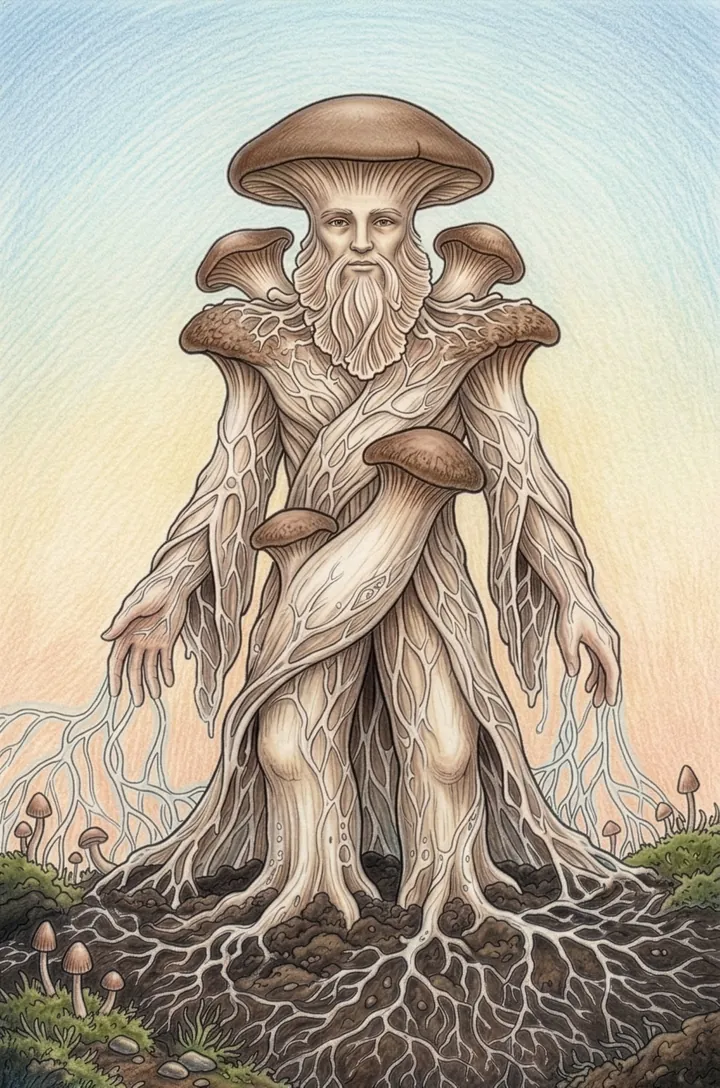
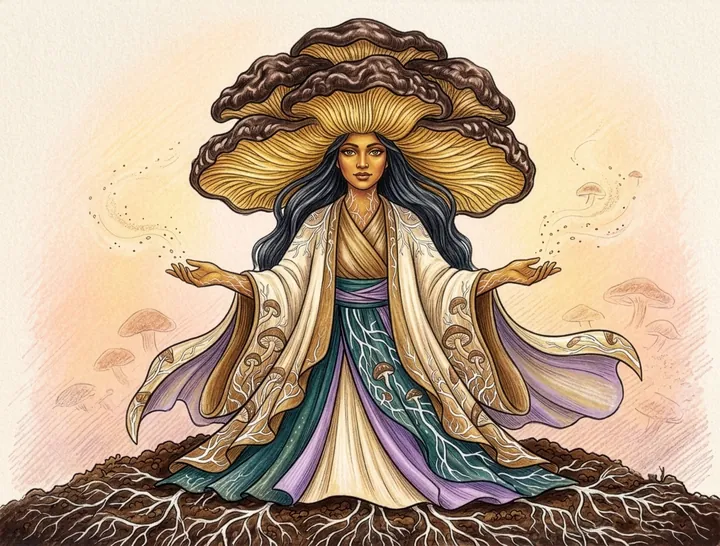
The Spore Cloud of consciousness watched, and was pleased.
The Children of the Web
In which land rises, and the Web pays attention to five things in particular.
The Great Web proved to have immense strength, and The Spore Cloud proved to have immense will, so they conspired together to command a giant mass of earth to rise above the waters.
Then Prozyfai and Rezyfai arose together from the center of the land and found the first garden steaming with possibility, and they fruited.
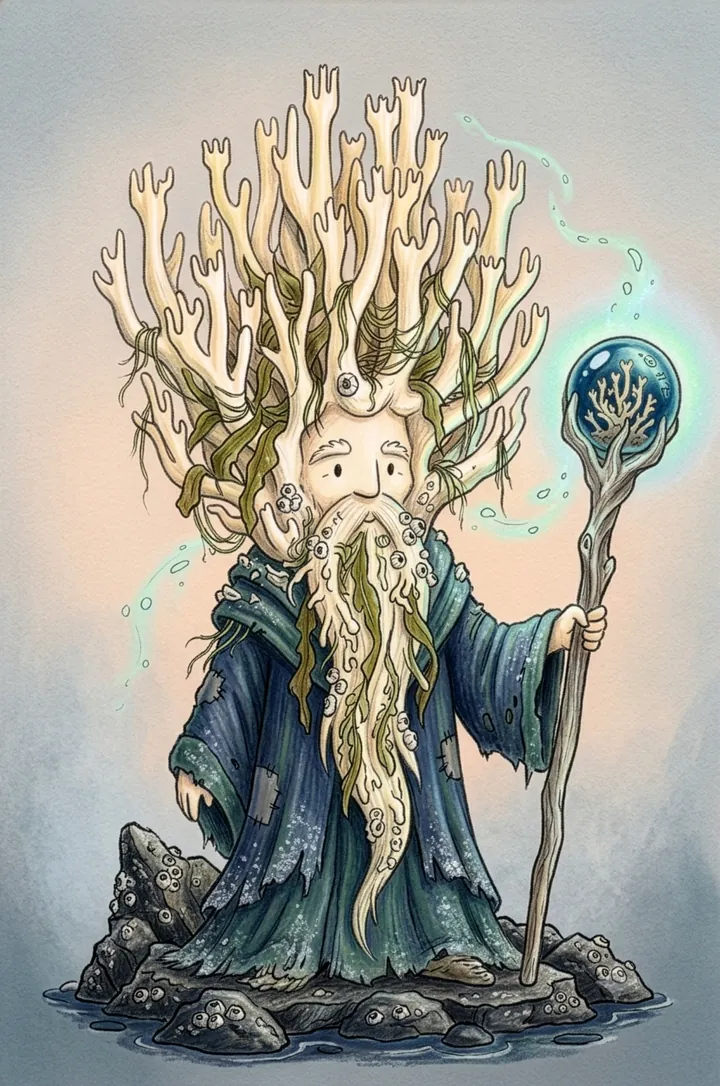
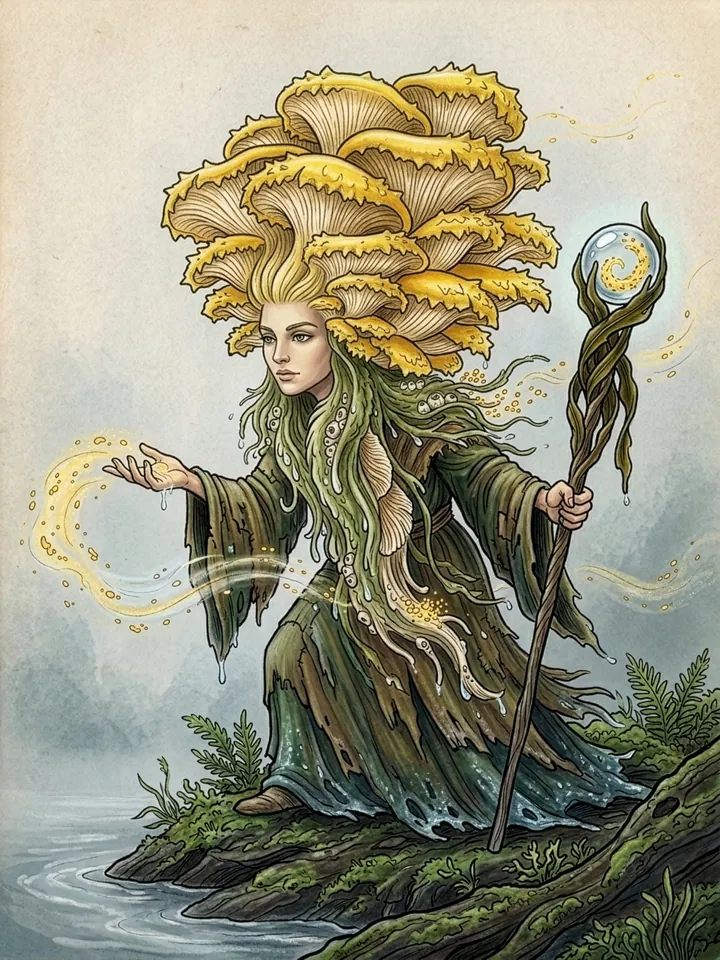
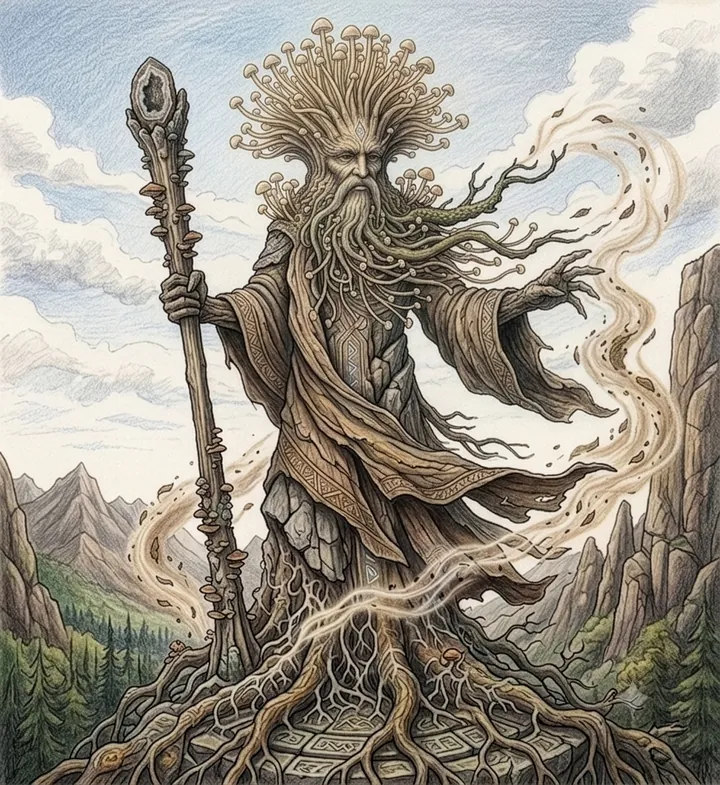
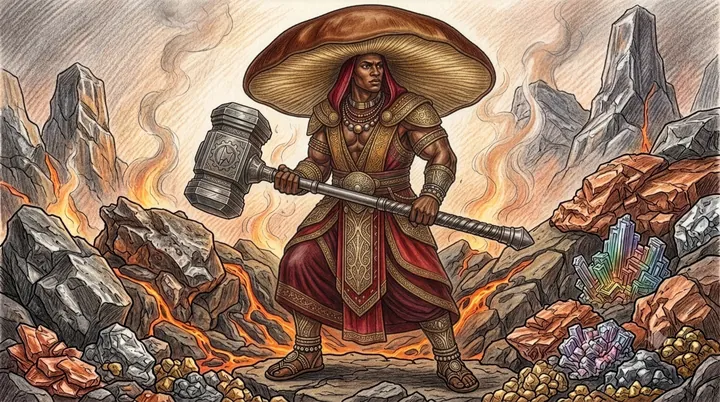
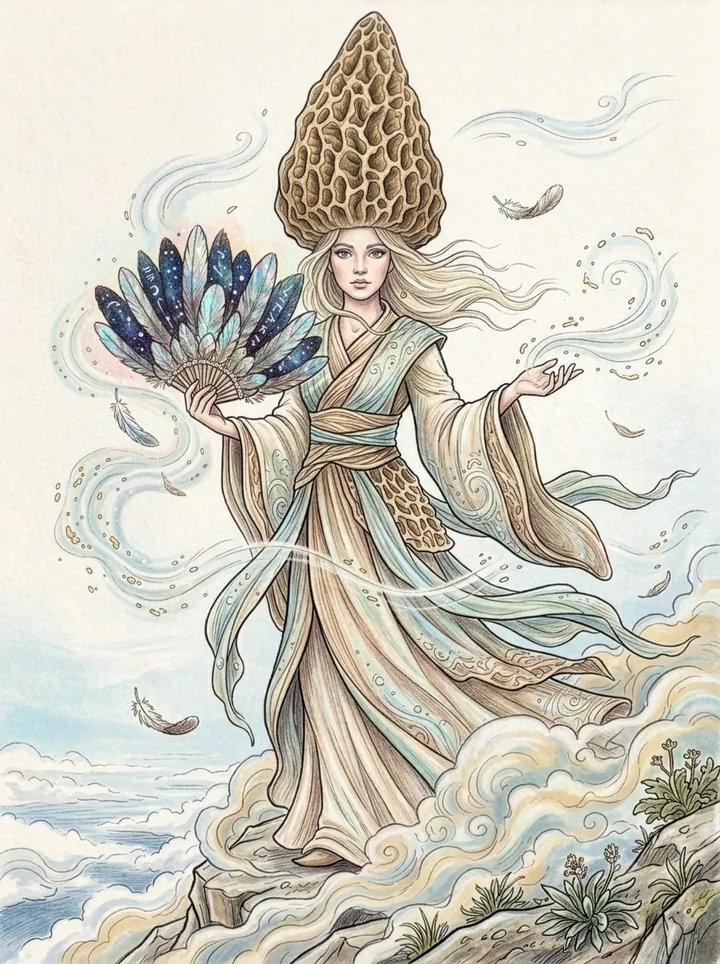
Their children were not born. They emerged from the network at points of tremendous concentration, each one an intensity, a specialization, The Great Web's way of paying particular attention to one thing.
There was Protaxiel, the god of the earth and stone. Protaxiel is said to remember the world before the first tree, though Protaxiel does not much talk about that time, only to say that it was a bit boring.
There was Chromusu, the god of fire and metals. The destroyer and renewer, the one who appears on scorched ground before anything else dares. Always where the fire is. Always where the fire was. Always asking everyone “why are you calling me a pyromaniac?”
There was Balidris, the goddess of air and wind and the great dispersal, the one who receives every spore that has ever trusted itself to the atmosphere. Balidris has watched every single one. This has taken a very long time, and Balidris finds it completely absorbing.
The Separation
In which the prime pair takes a break, and we get a sky out of it.
Then Prozyfai and Rezyfai, having brought forth five children into the world, decided to take a well-deserved break, and they briefly separated again.
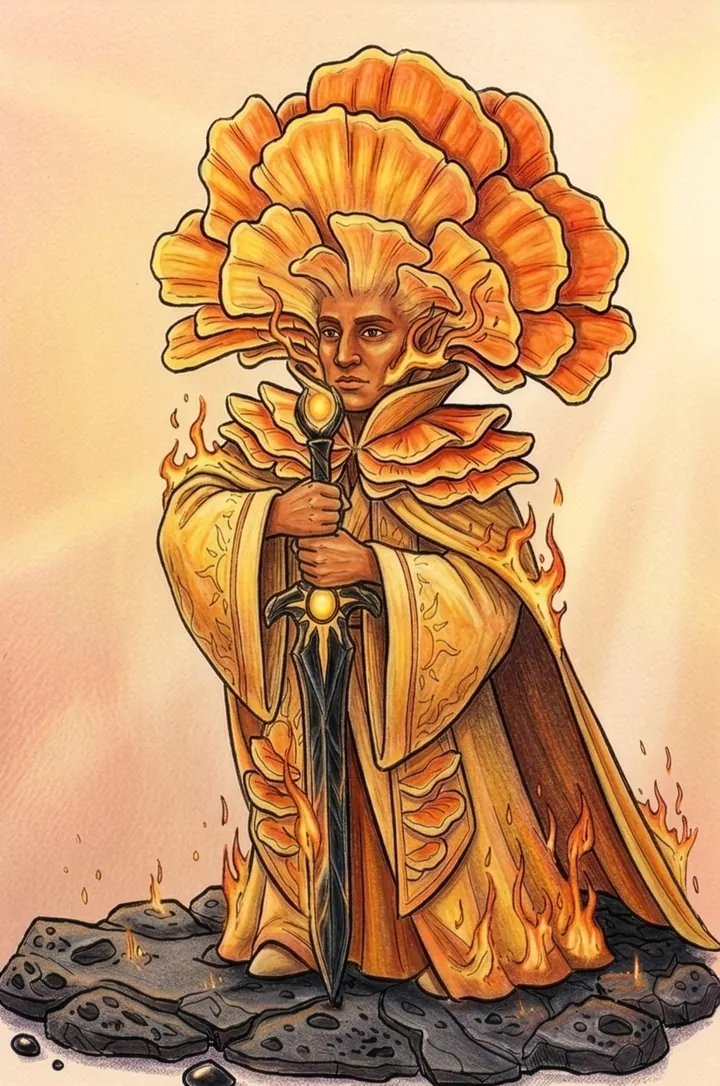
From Prozyfai's outward reach rose Soliphon, the god of the sun, the great warmth, the fruiting signal, the light that tells the Web when to push upward and show itself to the sky. Soliphon is not the sun. Soliphon is what the sun means to everything alive. The rhythm, the invitation, the annual insistence that now is the time...the time is now.
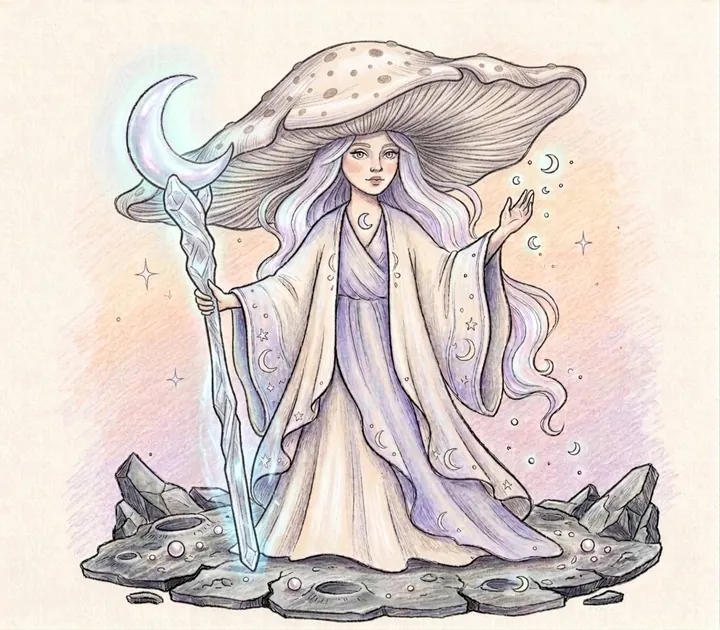
From Rezyfai's inward pull rose Luneth, the goddess of the moon, the tide-mover, the clock the Web consults when it is calculating whether to fruit, when to release, when to rest. Luneth never deviates in time and place, which is very rare and extremely useful, but also really annoying to many.
The separation of Prozyfai and Rezyfai was the cost of having a sky. After Soliphon and Luneth had risen, Prozyfai and Rezyfai reached back toward each other, and the Web grew denser at the point of their reunion, and that is where the first forest came from.
The One Who Went Down
In which someone goes down instead of up, and death turns out to be a kind of homecoming.
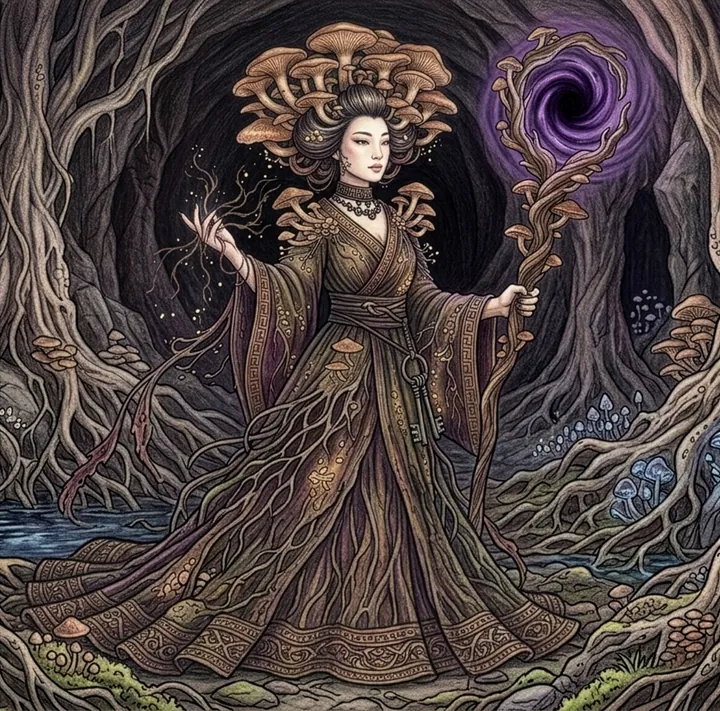
Last came Mycelius. Not from the surface, but downward, threading deeper than any of the others had gone, descending into the depths without stopping.
Mycelius governs the Suspor: the realm just below what the living can perceive, where everything that dies begins its return. Not paradise. Not punishment. Something older and stranger and ultimately more useful than either. A vast, slow dreaming dissolution into the Great Web itself, where the boundary between self and everything becomes nothing, and everything and the self become all.
Mycelius does not take the dead. Mycelius receives them, ushers, and comforts them through the transformation of the physical and the spiritual.
And thus the world was made, not in a single commanding moment, but the way all real things are made: slowly, by growth and contact and dissolution and recombination, in a process that has no beginning you can point to and no end anyone has reached yet.
The making is ongoing. The Web is still spreading. The Cloud is still expanding.
You are inside them right now.
The ground beneath your feet, and the air you breathe is the proof.
Chapters
May the Web hold you.